


Call your friend out!
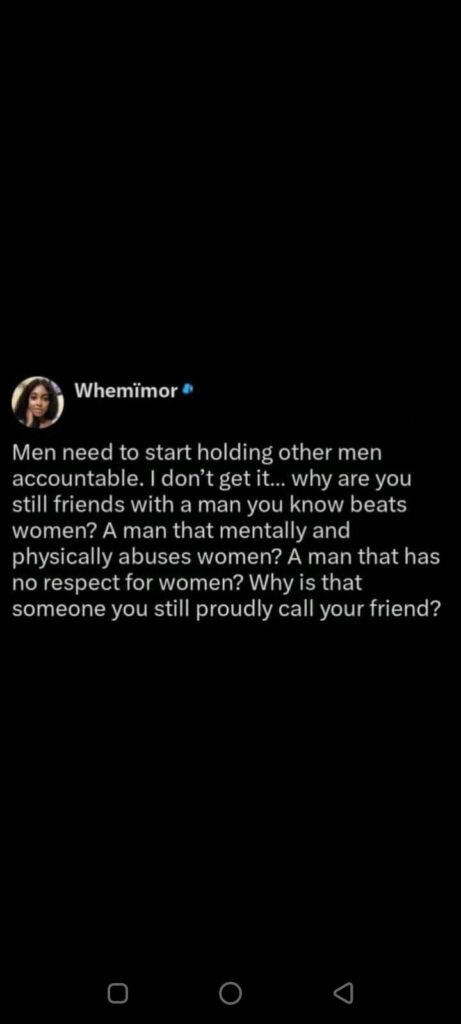
I saw a tweet recently that reminded me of something I had read before. The argument was that when women associate themselves with prostitutes, people are quick to say that they will naturally become like them. Yet when men associate themselves with men who abuse or disrespect women, they are not necessarily expected to become those things themselves. They can remain “a man and a friend,” even when the person they call a friend is abusive.
It made me think about how often men are expected to maintain loyalty to other men, even when that loyalty means remaining silent about behaviour that is clearly wrong.
I experienced this myself.
I was getting to know a guy I had met through a WhatsApp group. There was something peculiar about this group. It had more than 500 people, and men would regularly make degrading comments about women. What struck me most was not only what was being said, but how little anyone challenged it.
At first, I stayed quiet. It was a huge group. You don’t know how people will react, and when nobody else is saying anything, there is always that thought: Maybe I shouldn’t be the one to start something.
Then one day, someone sent a video. I didn’t even watch it closely enough to know the context, but a man commented underneath it:
“Na madem waive.”
He was essentially saying that women needed to be more beautiful.
I was angry. I initially responded with an annoyed sticker because I genuinely couldn’t understand what was funny or acceptable about the comment.
He tried to pull me into agreeing with him. I refused.
I asked him what was so funny or respectful about what he had said. He didn’t answer.
Instead, once I questioned him, some of the women in the group finally began speaking up too. The men responded with laughing emojis and eggplant emojis. Nothing meaningful. Just more disrespect.
Then, shortly after the conversation had died down, the man I was getting to know tagged his friend’s message and said:
“Naona umekuja kutafuta bibi,” followed by laughing emojis.
He didn’t challenge his friend’s comment. He didn’t say that the comment about women was inappropriate. He didn’t even acknowledge what had happened.
And I wondered: Why?
This mattered to me because I wasn’t looking at him as just another person in a WhatsApp group. I was getting to know him. Naturally, I wanted to understand what kind of person he was.
His silence told me something.
I had another experience that made me think about the same issue.
There is a cybercafé where I often go to have my work printed. I had known the owner for some time. He was someone I could have conversations with about different perspectives and ideas. We could disagree and still have what felt like a genuine debate.
Then he employed another man.
One day, we were talking about femicide in Kenya. It was a normal conversation about something happening in our country. But this new employee would occasionally make subtle comments about women and feminism. He would say things about how women use feminism to control men.
It wasn’t one dramatic statement. It was the repeated, sneaky comments that eventually became difficult to ignore.
After several weeks, I brought it up with the owner.
I asked whether he had noticed the way his employee talked about women.
He said something along the lines of, “Hmm, you’ve noticed too? Oh, so it’s that obvious?”
Yes. It was.
So I asked him what he thought about it and whether he had ever addressed it with his employee.
His response?
“We are used to him.”
I remember thinking: What?
I asked him, essentially, whether that meant he was enabling the behaviour.
He laughed.
And suddenly, I didn’t know how I was going to look at him the next time I went there.
This was someone who had previously expressed an interest in getting to know me better. But hearing that he had noticed the behaviour, understood that it was obvious, and still chose to tolerate it changed how I saw him.
My interest disappeared.
And this is why I keep asking myself:
Why is it so difficult for some men to call out other men when they disrespect women?
I don’t think the answer is simply that men don’t know the behaviour is wrong.
Sometimes, they do know.
They just don’t want to be the person who says it.
There is a social cost to challenging your friends. You might be mocked. You might be called a “simp.” You might be accused of choosing women over your friends. You might disrupt the group’s dynamic or risk being excluded from it.
So instead, silence becomes the easiest option.
And eventually, that silence becomes normal.
In the WhatsApp group, I became the person who would speak up whenever the conversation turned into another opportunity to insult women. Sometimes five men would be against me. Sometimes more.
Eventually, the conversations started dying because the group could no longer casually centre itself around degrading women without being challenged.
And what was interesting was that I knew there were men in that group who didn’t agree with what was being said.
They simply didn’t say anything.
After several days of men no longer making those comments, one man eventually tagged me and asked the other man who had repeatedly made the comments what had happened to him after I kept calling him out.
That moment made me realise something:
They knew.
They knew the behaviour was being challenged. They knew it could be challenged. But many of them still didn’t want to be the person who did it.
This is where male solidarity can become complicated.
Friendship and solidarity are not inherently bad things. But when loyalty to your friends becomes more important than accountability, it can protect harmful behaviour.
And this doesn’t only happen with sexist comments.
In the same group, there was a man who was in jail after an incident involving a female tout. His friends were asking group members to contribute money to help him, while insisting that the woman had lied about what happened.
The men were overwhelmingly against her.
What surprised me even more was seeing women joining them in defending him.
I commented that he should serve his sentence, and once again, I found myself being challenged by almost everyone.
But eventually, some other women and I pushed back. And one particular man finally spoke up against the man’s behaviour and also challenged the women defending him.
I remember thinking:
So they can speak up.
They can.
It isn’t impossible.
And that is important because I don’t believe that men should only speak up when the person being mistreated is a woman they know personally, a woman they love, or a woman they are attracted to.
It shouldn’t be about protecting women because they are women.
It should be about standing up for what is right.
Even something as simple as:
“That’s not okay.”
“That’s not cool.”
“You shouldn’t have said that.”
“What you did was wrong.”
can make a difference.
It doesn’t make you less of a man.
If anything, it shows that your friendship isn’t based on blindly protecting someone from accountability.
I also think gendered ideas about conflict play a role in this.
Women are often told that they are overreacting. That it was just a joke. That it wasn’t that serious. That they are being too sensitive.
But what exactly are women supposed to laugh at when the joke is built around disrespecting them?
Calling something a joke doesn’t automatically make it harmless.
I’ve also thought about this through what I learned in my gender psychology class. Our lecturer would ask us open-ended questions about gender differences and whether men actively contribute to women’s equality.
And my answer has never been that men don’t.
There are men who do.
There are men who challenge their friends. Men who call out sexist behaviour. Men who take accountability. Men who don’t see standing up for women as an attack on their masculinity.
Those men exist.
And honestly, I pay attention to them.
I’m quite strict about the people I allow into my life, particularly men I consider friends or men who are interested in me.
I want to know how you think about other men.
What do you do when your friend disrespects a woman?
Do you laugh?
Do you remain silent?
Do you defend him?
Do you say, “That’s just how he is”?
Or do you tell him that he is wrong?
Because I don’t expect every man to be perfect. I don’t expect everyone to agree with me on everything.
But I do expect people to have principles that extend beyond their friendships.
You don’t have to be a woman to care when women are being disrespected.
And you don’t have to be a man to recognize that another man is wrong.
For me, that is the difference between solidarity and complicity.
You can be someone’s friend without being their excuse.
And sometimes, being a good friend means being willing to tell your friend:
“You’re wrong.”

